

The Protein Question
How much, too much, enough already?

We are in the middle of a proteinaceous moment. A recent national survey found that 70% of Americans “want to eat more protein.” That’s more than any other nutrient or vitamin, up from 50% just two years earlier. Searches for “high protein” are peaking. I’ve heard that social media is full of people narrating their daily gram counts. And two of the figures most responsible for popularizing very high intake, Peter Attia and Andrew Huberman, both hold financial stakes in a protein-bar company grossing $180 million in annual sales.
When the people urging you to eat three times the recommended amount of something also profit from it, it’s worth looking carefully at the evidence before following along. Chicken and beef, bars and powders, tofu and crickets. So I researched what I could on this airplane, and here is my take. References include one of my own posts about the sketchily inverted food pyramid, a post by Dr. Eric Topol, and a plethora more upon request from OpenEvidence (otherwise formatting hyperlinks on an iPad is too painful!).
What “high protein” even means
The longstanding recommendation of 0.8 grams per kilogram of body weight per day was not meant to be optimal. It’s the floor, the amount that prevents deficiency in a healthy adult, derived decades ago from nitrogen-balance studies. Few Americans fall below it. By USDA figures, more than half of men and a third of women already exceed it, and roughly a quarter of us eat double.
The influencer target is something else. Last I checked many including Attia recommend 2.2 g/kg/day, close to three times the usual number. What are the possible benefits, and more importantly, are there risks to consuming this much protein? Beef at the top left of the food pyramid?! What are the best sources of protein? Is there a convergent conspiracy between sincere ideologies and notable conflicts of interest?
Maybe there is room for compromise and healthy debate, even as everything in America careens towards conflict and extremism? The controversial 2025 Dietary Guidelines raised the recommended target to 1.2–1.6 g/kg/day. That is a meaningful increase, and it rests on some decent justifications. So maybe the disagreement that actually matters, then, is not between 0.8 and 2.2. It is between a reasonably well-supported move toward 1.2–1.6 and a fashionable leap to twice that.
Let’s dive in…
Where more protein genuinely helps
There are situations where eating more protein is clearly wise, and we shouldn’t lose them in the skepticism.
The first is weight loss. In a calorie deficit, higher protein helps preserve muscle while we lose fat, and it helps us feel full. The effect on the scale itself is modest (meta-analyses put it somewhere between 1-5 pounds of advantage) but the benefit to body composition is the real point. We want to lose weight, but not become weaker. This matters more than ever now that so many patients are taking GLP-1 medications, where muscle loss is a real concern. For them, adequate protein paired with resistance training can be crucial rather than optional.
The second is aging. After about sixty-five, muscle becomes somewhat less responsive to protein (a phenomenon called anabolic resistance). The slow erosion of muscle can lead to sarcopenia (poor body muscle), one of the under-recognized threats of later life. Here the evidence supports a modestly higher intake, around 1.0 to 1.5 g/kg/day. But protein on its own does very little for aging muscle. The benefit appears only when it is paired with resistance training. We can’t just gobble down bars, powders, chicken breasts. The protein is just the raw material but the movement is the signal to build with it. Without some exercise, much of the extra is simply spun into generic calories or even excreted.
Here’s a summary of the ranges recommended by different sources and in different situations:
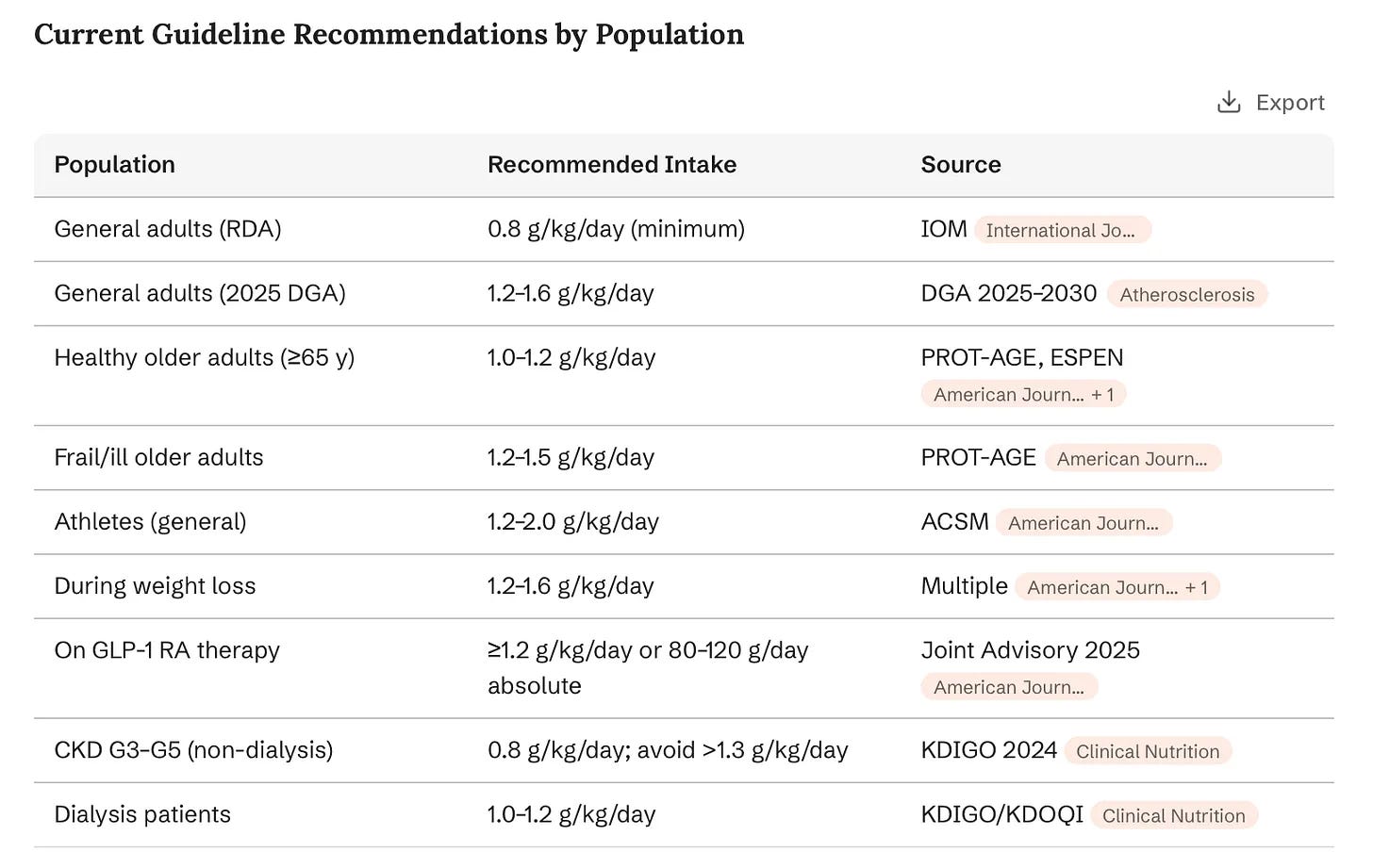
A few points of nuance and clarification are in order. The traditional RDA of 0.8 g/kg/day at the top represents the minimum to prevent deficiency, not optimal intake, and has been criticized as insufficient for muscle preservation, especially in older adults. The updated 2025–2030 Dietary Guidelines now recommend 1.2–1.6 g/kg/day based on evidence for muscle, satiety, and metabolic benefits. But these were also heavily influenced by MAHA and RFK adjacent ideologies, so read on for more considerations.
For individuals with obesity, protein targets should be based on adjusted or ideal body weight rather than total body weight, since adipose tissue does not require the same protein support as lean mass.
Higher intakes up to 2.0 g/kg/day may benefit athletes, older adults with sarcopenia risk, and post-surgical patients, though evidence for benefit beyond 1.6 g/kg/day in the general population remains limited.
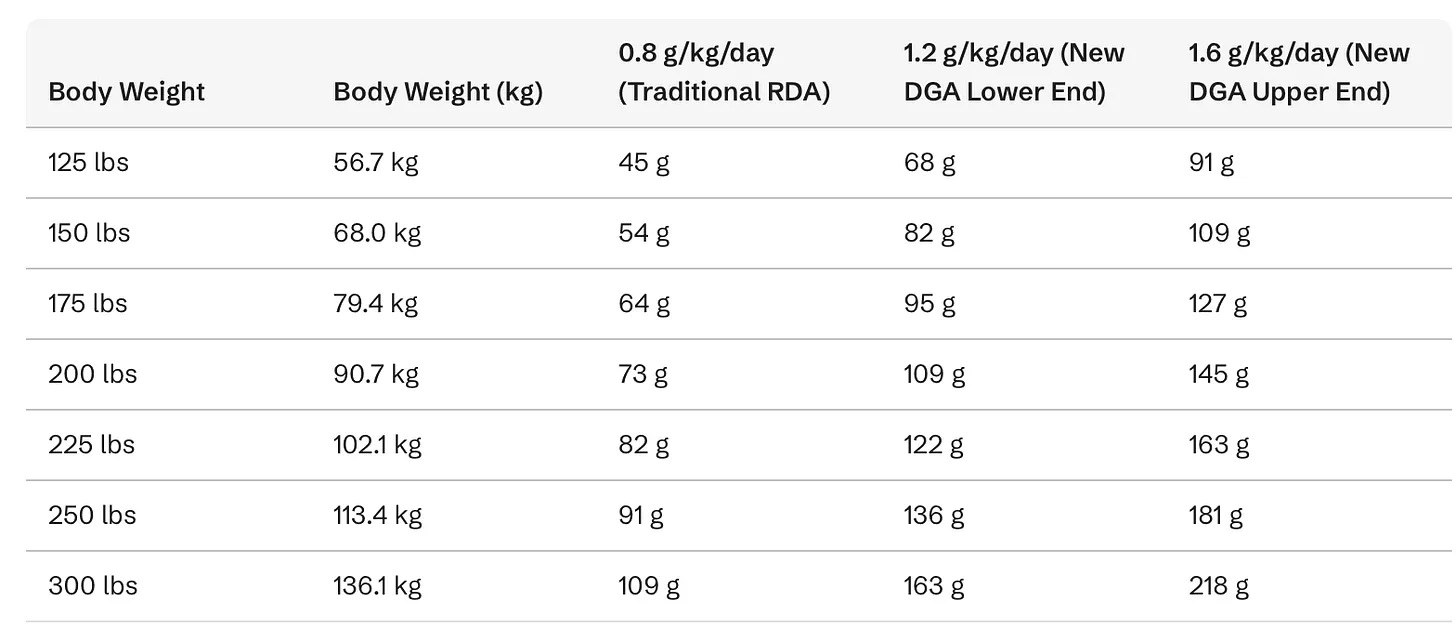
I don’t know about you, but I suck at conceptualizing protein based on the metric system. So here are some translations into typical American pounds of body weight, and grams of protein per day. I’m including 300 pounds to demonstrate the folly in just following grams of protein per unit of body weight… otherwise people at these higher weights would be chasing over 200g a day!
And now, here is a sampling of grams of protein from some common foods.
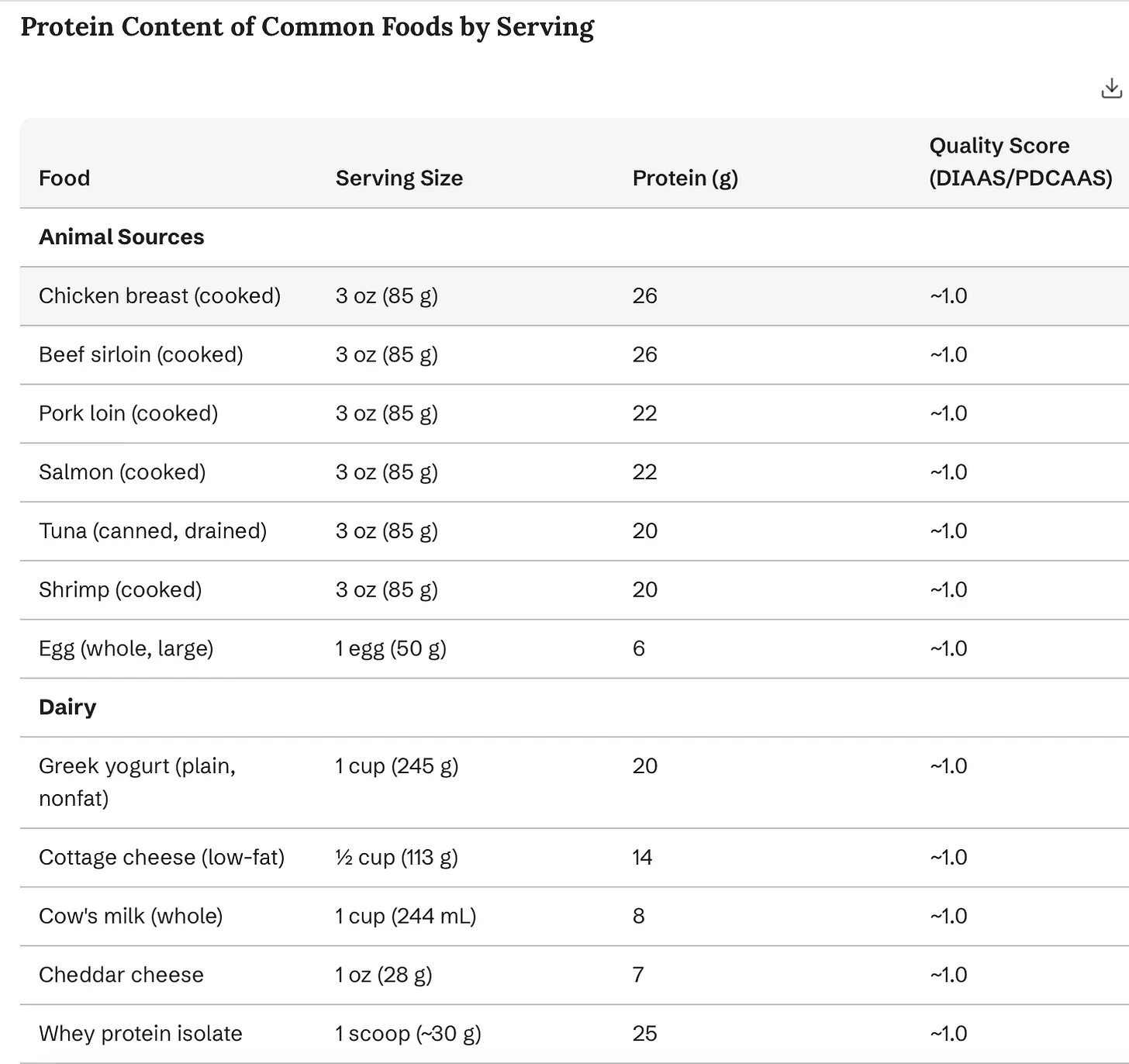
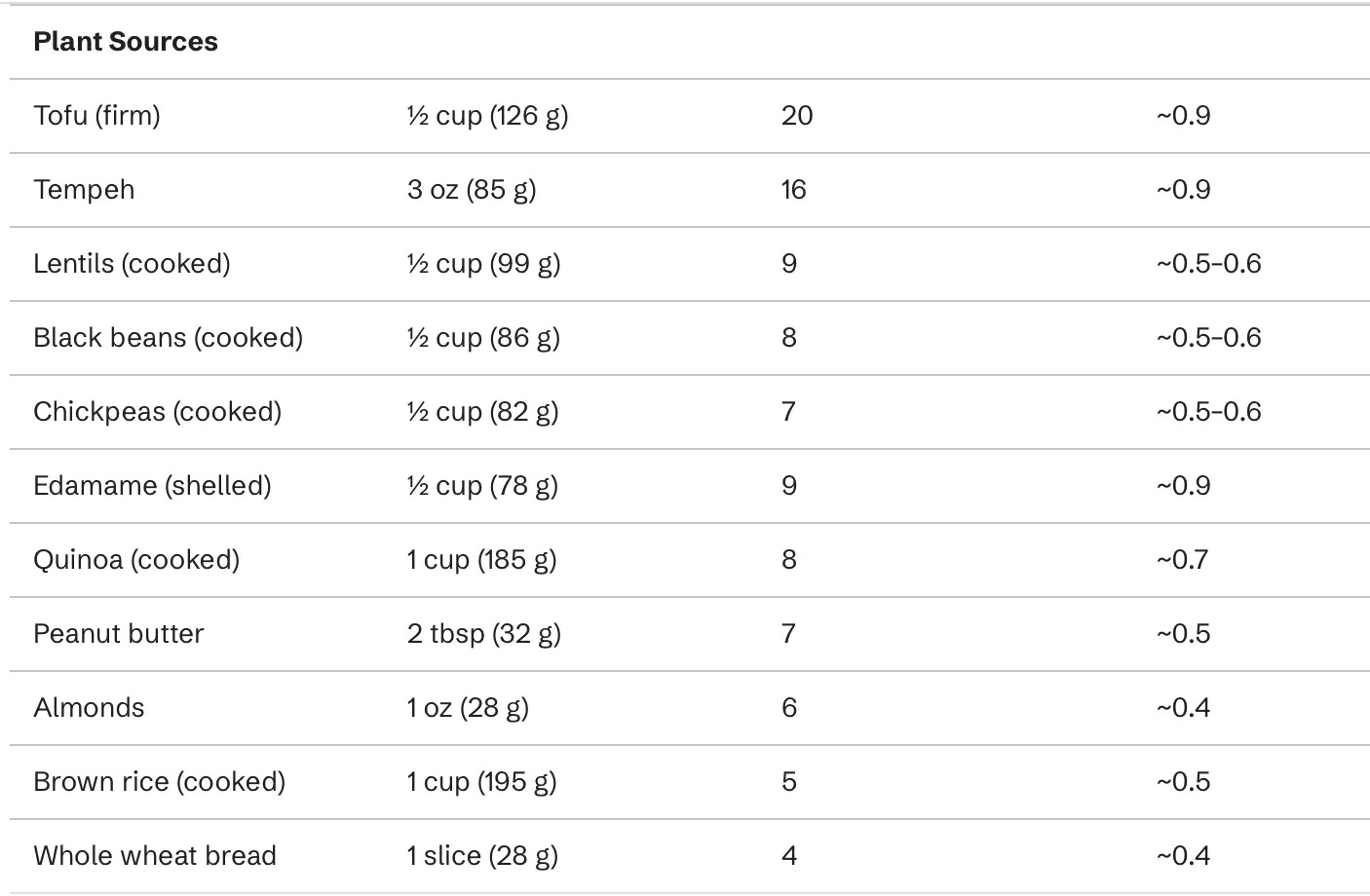
In this table you’ll see a “protein quality score.” This estimates how well a food provides all nine essential amino acids in digestible form, scored using a system where 1.0 is the highest rating. Animal proteins (meat, dairy, eggs) consistently score ~1.0, while most plant proteins score lower (0.4–0.7) due to limiting amino acids, particularly lysine in grains and methionine in legumes — meaning larger portions or complementary combinations are needed to achieve equivalent metabolic benefit. Vegans especially have to know this nutritional science to get all their essential amino acids.
Where the evidence runs out, and where we might have concerns
Is there too much of a good thing? Usually the answer to this generic question is yes.
Several lines of research now implicate leucine (the amino acid most abundant in animal protein, and the one some athletes supplement deliberately) in activating a cellular pathway called mTOR. When chronically overstimulated, mTOR appears to accelerate atherosclerosis in animal models, with similar signals in humans. Large observational studies link habitually high intake, particularly of animal protein, with more cardiovascular disease and higher mortality, and there is a cancer signal in middle age tied to elevated IGF-1 that appears to reverse after sixty-five.
To get a general sense of where the studies suggest potential problems with eating too much animal protein, but not necessarily plant protein, check out this table below:
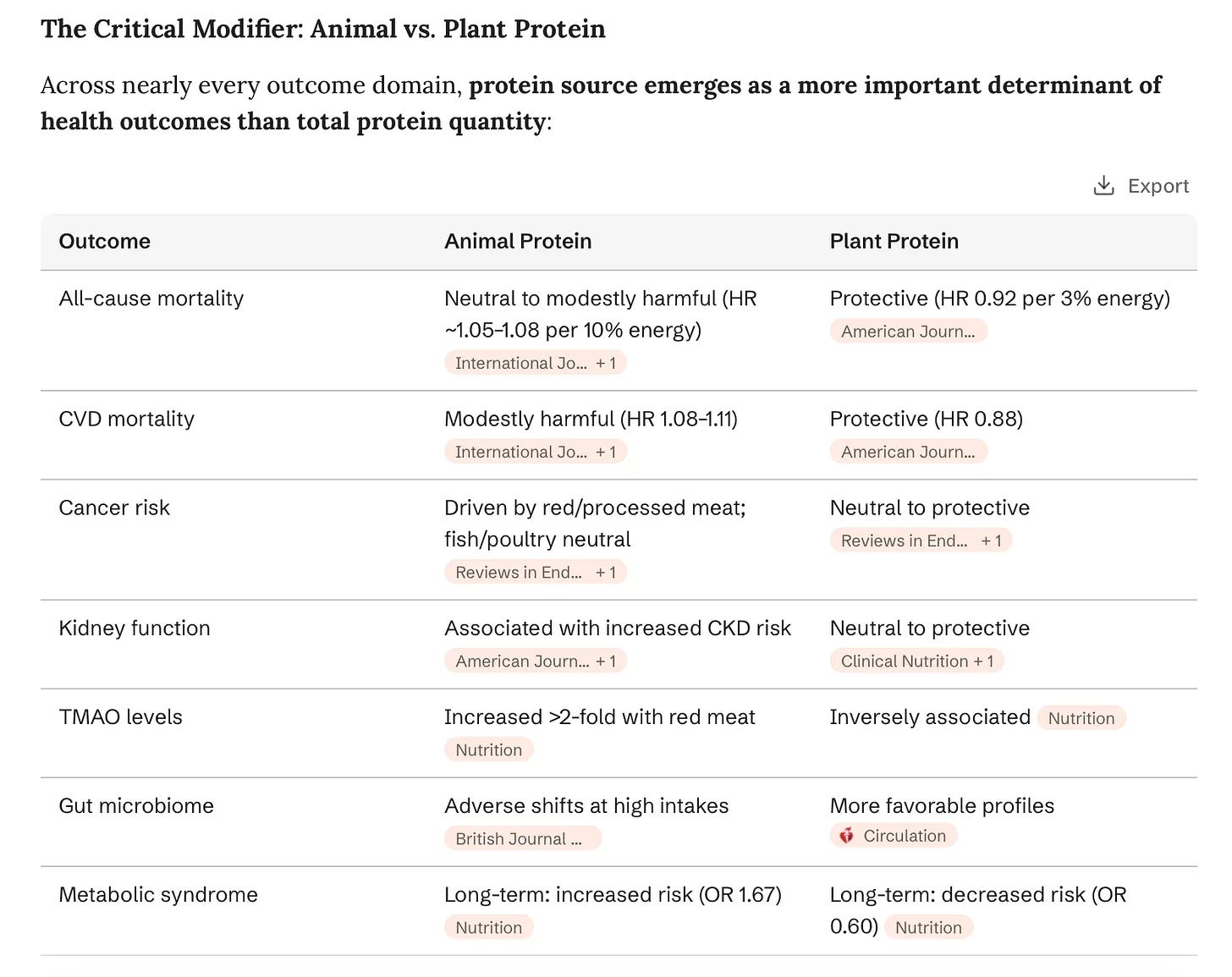
We should consider these findings loosely, because most of the work is observational or done in mice. But it usually comes back to all things in moderation, not eat as much as you like because too much protein can’t hurt you. At the extremes, like pretty much everything, it plausibly can.
Instead we see that the clearer and more useful lesson is about source. Across most outcomes like mortality, heart disease, kidney health, the kind of protein matters more than the amount. Plant protein is consistently associated with lower all-cause and cardiovascular mortality, while the concerning signals attributed to “animal protein” come mainly from red and processed meat, not fish, poultry, or dairy. Replacing even a small amount of processed-meat protein with plant protein tracks with meaningfully lower mortality.
I had to look up TMAO (trimethylamine N-oxide). It’s a metabolite produced when gut bacteria convert nutrients found mainly in red meat into trimethylamine, which the liver then oxidizes to TMAO, a compound linked to increased cardiovascular risk through promotion of atherosclerosis, platelet reactivity, and inflammation.
We also need to consider the massive environmental and energy costs of producing red meat as our planet is really screwed, and therefore so are every one of us. Cows are sweeties, too.
The red meat and methane diet

You have probably seen the inverted food pyramid rolled out by the people in charge right now. There are some good ideas and some bad ideas, but mostly just nutrition by fiat. And what particularly troubles me is the emphasis on red meat, both for our own health and the habitability of our feverish planet.
Politics and ideology
Briefly.
The 2025–2030 Dietary Guidelines for Americans, heavily shaped by RFK Jr. and the MAHA initiative, markedly elevate protein targets and explicitly promote animal‑source protein (red meat, full‑fat dairy, eggs) as “real food.” They downplay concerns about saturated fat compared with prior mainstream guidance, while sharply elevating concern about seed oils and ultra‑processed foods. Concerns like the ones I mentioned above about red meat are usually dismissed. More tallow. Gross. At the same time, news sources have documented substantial financial ties between key new nutrition advisors and meat/dairy industry groups, raising conflict‑of‑interest concerns, even though formal findings of corruption have not been made. A careful characterization is that their final dietary guidelines come from a mostly sincere, MAHA‑aligned preference for animal protein and animal fats, though ignoring much inconvenient evidence about risks, and then accepting convenient reinforcement by industry‑aligned conflicts of interest.
What I will tell patients
If you are reading this then rest assured; you are probably getting enough protein already. No worries. The daily gram-counting and gaming burns mental calories on a problem you most likely don’t have. Bars and powders you probably don’t need.
The real exceptions deserve attention: adults past their mid-sixties, who lose muscle more readily, and anyone losing weight (especially on a GLP-1 medication) who needs to protect lean mass. In both, protein works only alongside resistance training. Without that, the extra mostly passes through.
Consider the newly increased 1.2–1.6 g/kg/day guidance loosely, too. It was hatched through a politicized process with industry ties, despite ironic protestations to the contrary, not the usual evidence-based one. And the nuance of animal versus plant protein is just not there at best, upside down and ideological at worst.
Source matters more than amount. Shifting from red and processed meat toward beans, nuts, fish, poultry, and Greek yogurt tracks with lower mortality and a lighter burden on the planet.
Protein is a building material, not a cure.
I like to enjoy mine when I eat it, rather than thinking of literally everything as a longevity and wellness tool of optimization to be commodified.
Take good care!
P.S. I’ll respond to any comments in a couple days 🌞
Thank you for this, Doc. The tables were helpful too, especially the one that frees us from the shackles of the metric system 😆.
I feel a bit concerned for me and my husband. We are pescatarians who eat mostly plant-based (fish/seafood maybe once a week). It is much harder to hit the new minimum with just tofu, eggs, dairy, beans, nuts, etc. without consuming large quantities. I usually boost my Kodiak protein oatmeal with high quality whey powder. I know that sentence probably sounds influencer-nuts, but I’ve done the math and I can’t seem to hit the target without doing things like that. I’d love to not think about my protein intake so much, but I think our circumstances give me little choice. My husband turns 65 in a month, to boot.
I hope you are off having fun and thanks as always.